AI architecture & integration
First the data. Then the agent.
We take over the operations work your team still does by hand. Live in about a month, on your infrastructure.

What you end up with
Everything scattered on the left. One database in the middle. People and machines reading the same truth on the right.
What you have now
- ERP
- Warehouse system
- Spreadsheets
- Email & PDFs
- Supplier portals
One structured database
MySQL · one schema · one definition per number · full audit trail
What it feeds
-
Dashboards
One screen instead of twelve spreadsheets.
-
An AI agent
Reads the data, builds tools on demand, acts inside limits enforced in code.
Decisions written back into the systems you already run
Cheaper, faster and easier to stop than a hire
- Cheaper than the hire
- One fixed project fee, against €50,000–€70,000 a year, every year.
- It never calls in sick
- No holiday, no sick leave, no notice period. It works on the 24th of December too.
- Live in a month
- About four weeks from kickoff to the process running in production.
- Warranty, then no retainer
- Ninety days fixed at our cost. After that it repairs itself and you owe nothing.
- Everything in your name
- Your servers, your accounts, your repository, from day one. Nothing to hand back.
- Engineers, not a demo shop
- Five-plus years of production data platforms, long before the AI wave.
Project Factory
Every project runs through one factory
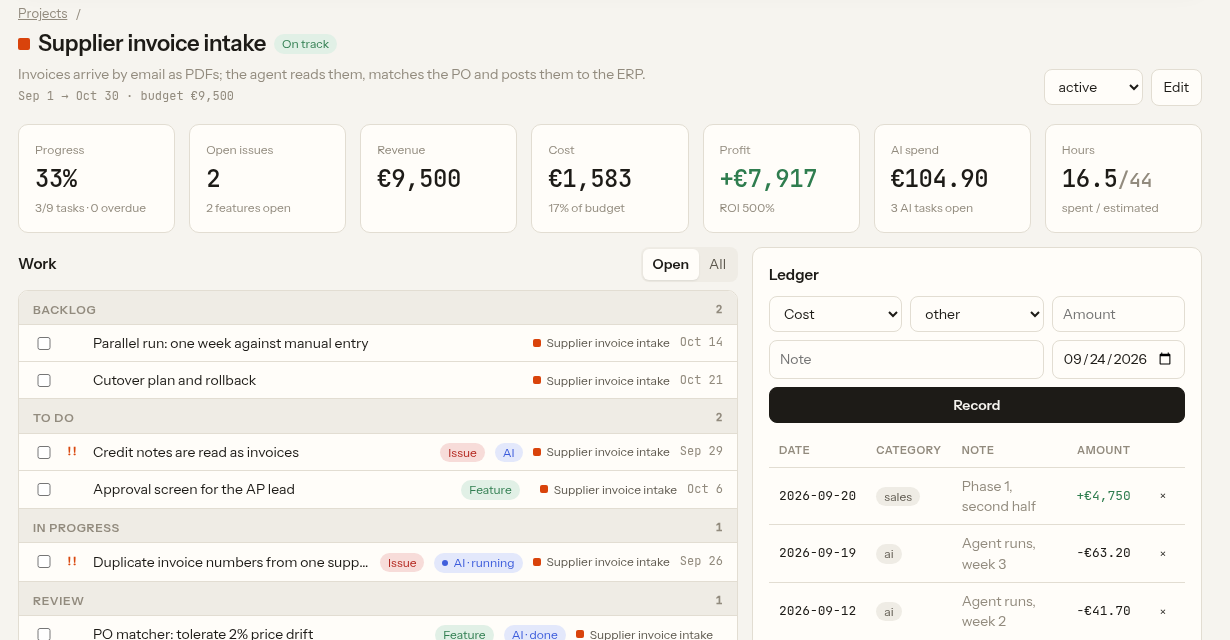
Tasks, bugs and feature requests land in one queue. Agents take the routine work, a person signs it off, and you see what each project costs and earns.
- 01
One intake
Anyone on your team files a task, an issue or a feature request in one line.
- 02
Agents do the routine part
Work marked for the AI runs on its own and waits in review until a person approves it.
- 03
Cost and revenue per project
Every AI run books its own cost. Progress, spend and return are on one screen, no report needed.
It comes with every engagement, runs on your servers, and stays yours when we leave.
The internal desk work: management and operations
Most of what we replace is not a person. It is the vacancy you have spent four months failing to fill, and the overtime your team is absorbing while you try. It is the part of the week that is reading, re-typing, checking and chasing: the work nobody was hired to do and everybody ends up doing.
- Order and invoice handling
- Reporting and month-end
- Master data upkeep
- Reconciliation and stock checks
- Request triage and routing
- Planning and follow-up
Compare it to the job description you were about to post.
| An operations hire | The same work, automated | |
|---|---|---|
| Year one | €50,000–€70,000 fully loaded | One fixed project fee, typically €12,000–€25,000 |
| Year two | The same again, plus the raise | Nothing. You own it outright. |
| Hours covered | About 1,700 a year, in office hours | 8,760 a year, nights and weekends included |
| Absence | Holiday, sick leave, notice periods | None. It does not take leave and does not resign. |
| A volume spike | Overtime, temps, or another hire | The same system, more throughput |
| When they leave | The process knowledge walks out with them | Documented, in your repository, in your name |
| Time to productive | 3–6 months to hire, onboard and train | About a month for a standard scope |
Year one
An operations hire
€50,000–€70,000 fully loaded
The same work, automated
One fixed project fee, typically €12,000–€25,000
Year two
An operations hire
The same again, plus the raise
The same work, automated
Nothing. You own it outright.
Hours covered
An operations hire
About 1,700 a year, in office hours
The same work, automated
8,760 a year, nights and weekends included
Absence
An operations hire
Holiday, sick leave, notice periods
The same work, automated
None. It does not take leave and does not resign.
A volume spike
An operations hire
Overtime, temps, or another hire
The same work, automated
The same system, more throughput
When they leave
An operations hire
The process knowledge walks out with them
The same work, automated
Documented, in your repository, in your name
Time to productive
An operations hire
3–6 months to hire, onboard and train
The same work, automated
About a month for a standard scope
These ranges are typical for mid-market operations roles in Northern Europe and for the projects we deliver. They are not a quote. We work out the real number for your process (including what it is costing you today) before you commit to building anything.
From scattered data to a process that runs itself
The same route, every engagement, and you see real screens from our own production systems along the way.
-
One database, not nine
Every source into one structured MySQL schema.
How
Everything the business runs on gets pulled into a single structured MySQL database: the ERP, the warehouse system, the spreadsheets, the exports somebody emails round on Fridays. One schema, one set of definitions, one place to look. From that point a number means the same thing everywhere, dashboards take an afternoon instead of a quarter, and anything downstream, whether a person or a machine, can be trusted to read it.
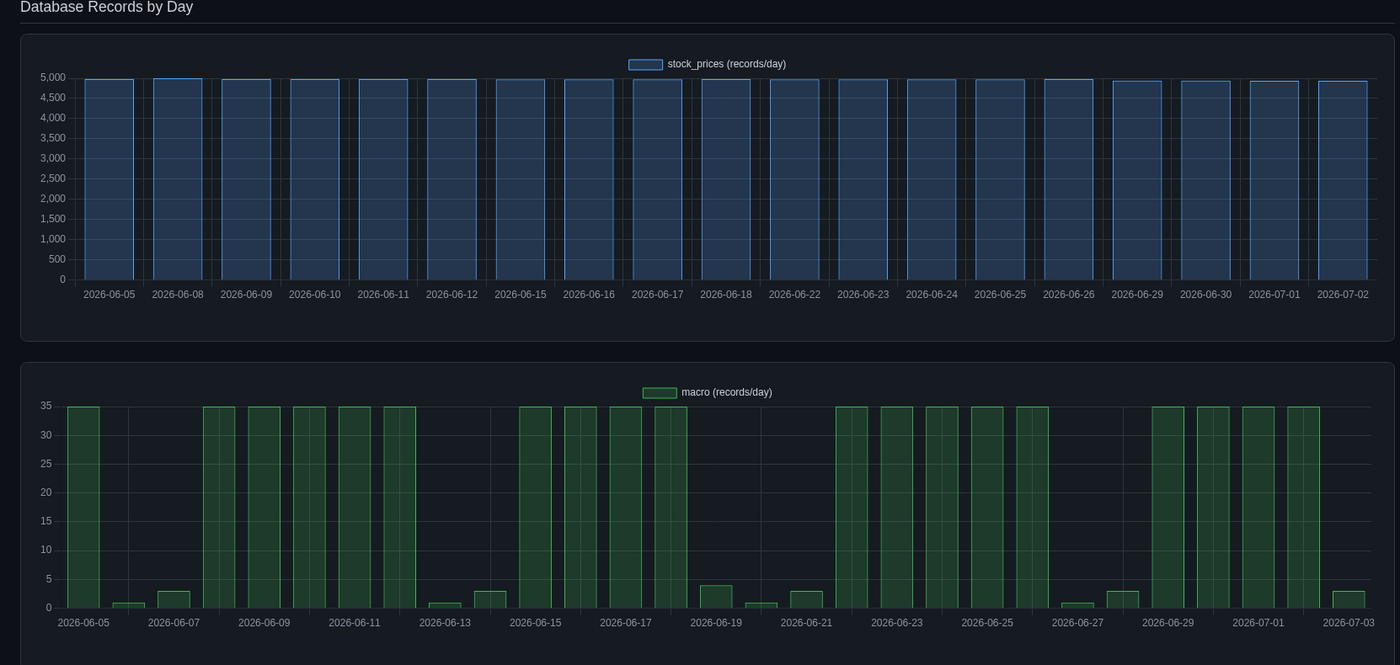
Our own ingestion monitor: every source table filling itself on schedule. -
Find what actually hurts, then rebuild that one piece
Rebuild the one piece that actually costs you.
How
We sit with the people doing the work and find the part of the operation that genuinely costs you, which is rarely the part anyone had budgeted for. Then we rebuild that specific piece of software properly, instead of proposing to replace everything you own. Small surface, real fix, and something you can see working inside a month.
-
Reconnect it without stopping the operation
Parallel running, one process at a time, rollback at every step.
How
The new piece has to take over from the old one while the company keeps trading. Old and new run in parallel on the same inputs until the outputs agree, then we move one process at a time, with a rollback that takes an afternoon at every step. There is no weekend where everybody holds their breath and no Monday where nobody can invoice.
-
Put an AI on top of the database
An agent on the data that builds reports and automations on demand.
How
With the data finally in one shape, we deploy an agent that reads it directly and builds on demand: a new report, a new check, a new automation, the chart somebody needs for a board meeting on Thursday. Your team asks for it in plain language instead of raising a ticket and waiting a quarter. It works inside permissions and limits enforced in code, and everything it does is logged.
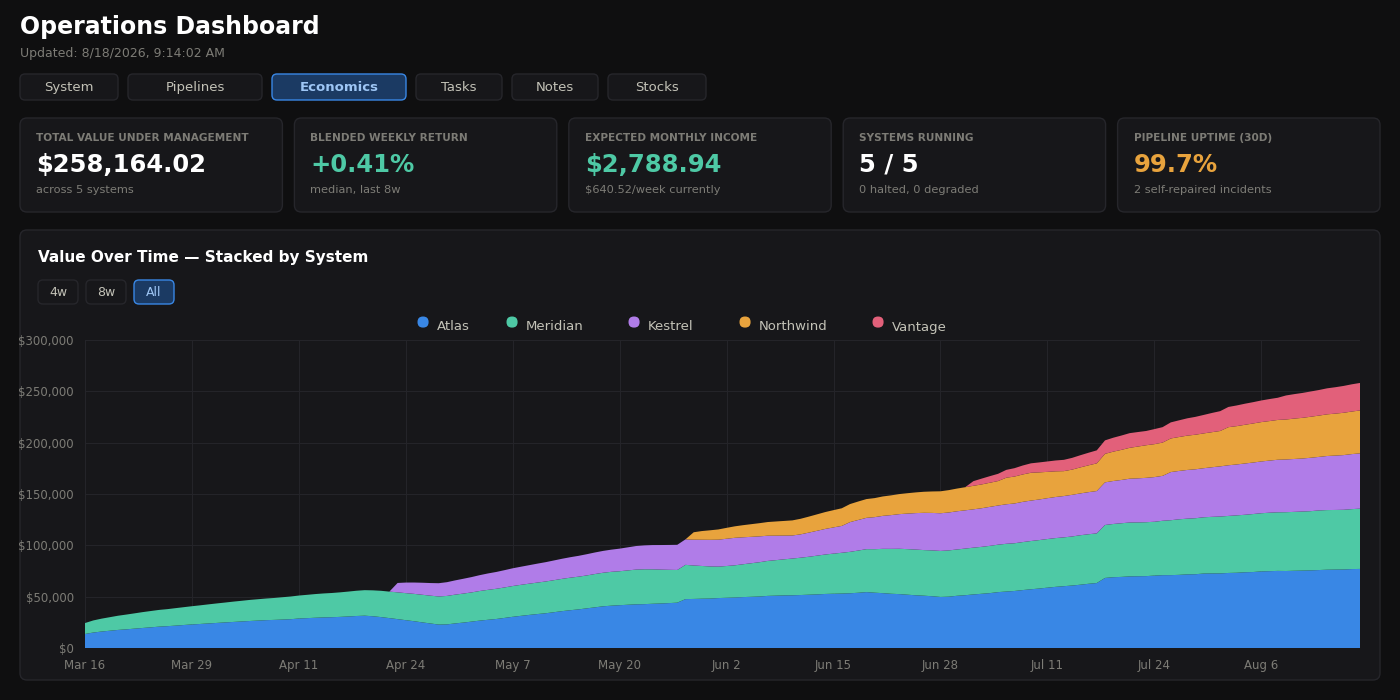
One of our operations dashboards (figures and system names are illustrative). -
A weekly review that comes to you
The system reports its own failures and proposes the fixes.
How
Every week the system reports on itself: what failed, what it repaired on its own, what has drifted, and what it proposes changing. During the warranty we act on it. After that it is your call: read it and decide, ask the agent to make the fix, or bring us back for the ones worth doing properly. What does not happen is the thing quietly rotting while everyone assumes it is fine.

Consultants reviewing the delivered system with the client.
Tell us what your team still does by hand
Two or three sentences are enough: what is done, how often, by how many people. We reply within two business days.
Half an hour, at no cost and with nothing to sign. Tell us what your team still does by hand and we will tell you straight whether any of it is worth automating, roughly what it would take, and what it would save. If there is nothing here worth doing yet, we will say so on the call rather than sell you a project. If there is, the next step is a written solution design, and that is where the work actually starts.
Our reference implementation